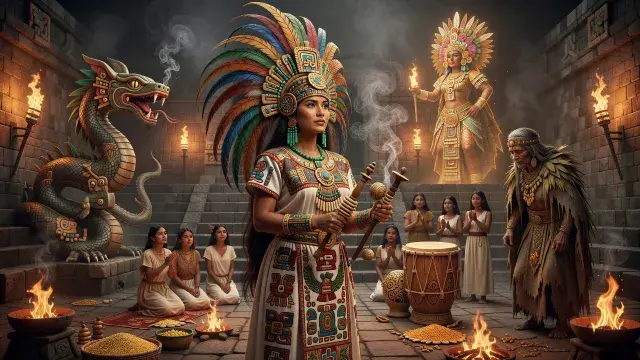
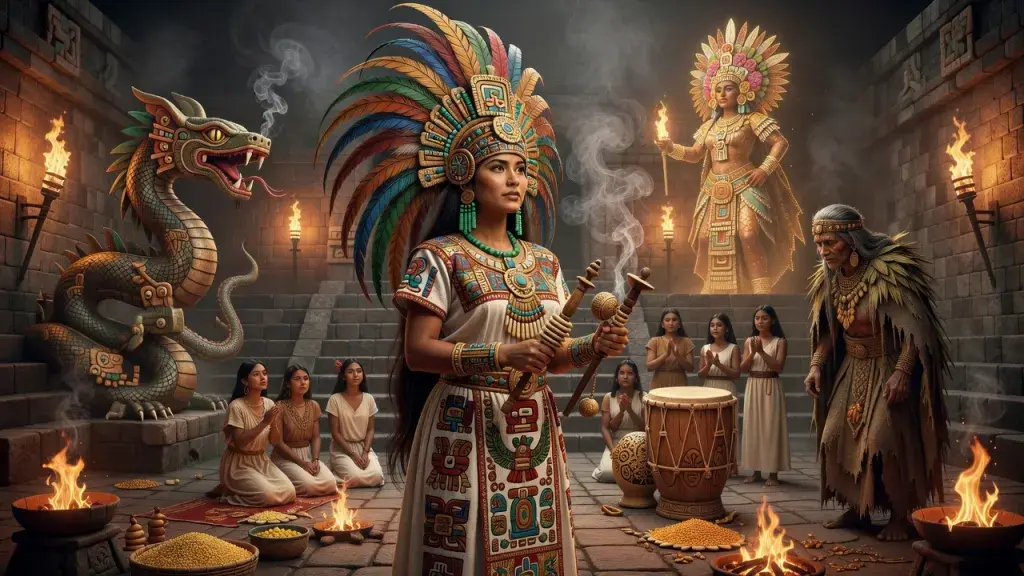
Blood, incense smoke, and the rhythmic beat of a huehuetl drum defined the sensory world of the Aztec temple - and women stood at the center of it far more often than popular imagination admits. The figure of the Aztec priestess rarely appears in mainstream retellings of Mesoamerican history, yet surviving codices, Spanish chronicles, and archaeological evidence confirm that women held genuine ritual authority within the religious hierarchy of Tenochtitlan. Their duties ranged from tending sacred fires to interpreting omens tied to fertility, war, and the agricultural calendar.
What makes this subject compelling is the gap between assumption and record. Many people picture Aztec religious life as an exclusively male domain of warrior-priests and human sacrifice, but the documentary evidence tells a more layered story. Modern interest in this history has even crossed into unexpected territory - an aztec priestess review of a popular slot game recently sparked renewed curiosity about the real women behind the myth, prompting players and history enthusiasts alike to ask how accurate these depictions actually are. That curiosity is worth satisfying with facts rather than assumptions.
This piece separates myth from documented practice, tracing the Aztec priestess mythology from its divine archetypes down to the daily obligations of temple life, and closing with a clear-eyed look at how historians reconstruct this vanished world.
Origins of the Aztec Priestess in Mythology
Aztec religious thought did not separate the sacred feminine from institutional practice - the two reinforced each other. Female religious figures in myth gave theological justification for the existence of women serving in temples, and the temples in turn ritually enacted the stories told about goddesses.
Goddesses Linked to Priestly Roles
Several goddesses in the Aztec pantheon carried direct associations with ritual specialists. Cihuacoatl, the "Snake Woman," lent her name to a powerful political-religious office, though it was typically held by men; her mythic character nonetheless anchored the idea that female divine power required earthly representation. Toci, "Our Grandmother," and Xochiquetzal, goddess of fertility and craftsmanship, were both honored through festivals administered by female temple attendants who impersonated these deities during key ceremonies.
Symbolism of Female Divine Power
Fertility, the moon, weaving, and childbirth formed a symbolic cluster tightly bound to feminine ritual authority. A woman serving in a temple was not merely an administrator of rites; she was understood as a temporary vessel for divine presence during festivals tied to agricultural renewal. This symbolic weight explains why certain ceremonies could only be performed by women, regardless of how much administrative power men held elsewhere in the priesthood.
Myths Featuring Priestess Figures
Origin narratives recorded by Spanish friars, particularly in the work of Bernardino de Sahagún, describe mythic women who served as intermediaries between gods and communities before the founding of Tenochtitlan. These accounts blend historical memory with theology, but they consistently reinforce one idea: female ritual specialists were present from the earliest imagined moments of Aztec civilization, not introduced as an afterthought.
The Role of the Priestess in Aztec Religion
Moving from myth to institution, the Aztec religion priestess occupied a defined place within a highly structured religious bureaucracy. Temples were staffed hierarchies, not loose collections of volunteers, and women entered this system through formal channels.
Temple Duties and Daily Responsibilities
Priestesses maintained sacred fires, prepared ritual foods and incense, wove textiles used in ceremonies, and cared for temple idols. Some held responsibility for teaching young women who lived in religious schools called calmecac or telpochcalli-affiliated female quarters, passing down chants, calendrical knowledge, and proper ritual conduct.
Rituals Led or Assisted by Priestesses
Women presided over ceremonies tied to maize cycles, childbirth protection, and specific festivals in the eighteen-month ritual calendar. During certain observances, a priestess would embody a goddess through costume and behavior for the duration of the rite, a practice called ixiptla. This was not symbolic theater in the modern sense - participants and observers treated the woman as genuinely inhabited by divine force during the ceremony.
Hierarchy: How Priestesses Fit Within the Priesthood
The priesthood operated as a graded system. Girls entered temple service young, often dedicated by their families, and advanced through ranks based on age, skill, and conduct. Senior priestesses supervised junior ones and managed the practical operations of female temple quarters, answering to male high priests only on matters requiring broader religious authority.
- Entry through family dedication, often before adolescence
- Training in chants, calendrical systems, and textile production
- Progression to supervisory roles over younger initiates
- Possible release from service for marriage, depending on temple and status
Historical Evidence and Records of the Aztec Priestess
Reconstructing the life of the historical Aztec priestess depends almost entirely on post-conquest documentation, since the Aztecs left limited pre-conquest written narrative of daily religious life. This creates both opportunities and problems for historians.
Spanish Chronicles and Codices
The Florentine Codex, compiled under Sahagún's direction with Nahua informants, remains the single richest source on temple life, including detailed descriptions of female religious duties. The Codex Mendoza and various local annals supplement this picture, though all such documents pass through the filter of colonial interests and Christian moral judgment.
Archaeological Findings Related to Female Clergy
Excavations at the Templo Mayor complex in Mexico City have uncovered offerings, figurines, and burial contexts that support textual claims about female ritual participation. Spindle whorls, weaving implements, and ceramic vessels found in temple precincts corroborate written accounts describing priestesses' involvement in textile production for religious use.
Challenges in Interpreting Historical Sources
Colonial authors frequently misunderstood or deliberately distorted indigenous religious roles to fit European categories of "priest" and "nun." A term applied loosely by a Spanish friar may obscure real distinctions in status, function, and authority that existed within Aztec practice. Historians today must read these sources critically, cross-referencing multiple accounts and archaeological data before drawing conclusions.
Aztec Priestess Mythology in Comparative Context
Placing the Aztec priestess alongside similar figures in other cultures clarifies what was distinctive about the Mesoamerican model and what fits broader patterns in ancient religion.
Similarities With Priestesses in Other Ancient Cultures
Like the Vestal Virgins of Rome or the oracle priestesses of Delphi, Aztec female clergy combined ritual purity requirements with specialized religious knowledge unavailable to ordinary community members. The pattern of dedicating girls at a young age also echoes practices found in ancient Mesopotamia and parts of the Mediterranean world.
What Makes the Aztec Model Distinct
The ixiptla practice - physically embodying a deity rather than merely serving as an intermediary - sets Aztec religious performance apart from many comparable traditions. Additionally, the integration of priestesses into a calendar-driven agricultural cycle gave their work an immediacy tied to survival that differed from more oracle-focused traditions elsewhere.
Aztec Priestess in Popular Culture and Modern Interpretation
Contemporary media has adopted the Aztec priestess as a recurring archetype, though rarely with historical precision.
Representation in Games, Films, and Literature
Video games, slot machines, and fantasy novels frequently borrow visual elements associated with Aztec priestesses - feathered headdresses, jade ornamentation, jaguar motifs - while inventing narratives disconnected from documented practice. These portrayals prioritize spectacle over accuracy, which is understandable for entertainment but can mislead casual audiences about actual historical roles.
Separating Myth From Historical Accuracy
A careful reader benefits from comparing entertainment depictions against primary sources like the Florentine Codex. The gap is often substantial: pop culture tends to sexualize or mystify the priestess figure, while historical evidence points toward a woman engaged in disciplined, skilled, and communally respected labor within a demanding religious institution.
Frequently Asked Questions
Did Aztec priestesses ever perform human sacrifice themselves?
Documented sources indicate that the act of sacrifice was overwhelmingly carried out by male priests, particularly those attached to major temples like the Templo Mayor. Priestesses participated in related ceremonies, processions, and preparatory rites, but primary evidence does not support them as the ones wielding the sacrificial knife in most contexts.
Could an Aztec priestess marry or leave temple service?
Yes, in many cases. Depending on the temple and the woman's specific role, service could be temporary, ending when a family arranged a marriage or when a woman reached a certain age. Some senior figures, however, remained in religious service for life, particularly those who advanced to supervisory positions.
What qualifications were needed to become a priestess?
Selection often began with family dedication during childhood, followed by years of training in ritual chants, calendrical knowledge, weaving, and proper conduct within temple precincts. Physical purity, discipline, and memorization ability mattered greatly, since much religious knowledge was transmitted orally rather than through writing.
How reliable are Spanish colonial accounts of Aztec priestesses?
They are useful but require careful, critical reading. Authors like Sahagún worked closely with Nahua informants and produced detailed records, yet colonial bias, mistranslation, and attempts to fit indigenous roles into European religious categories can distort the picture. Cross-referencing with archaeology strengthens confidence in specific claims.
Are there any surviving names of historical Aztec priestesses?
Very few individual names survive in the historical record, unlike the numerous named male priests and rulers documented in chronicles. This absence likely reflects both the record-keeping priorities of Aztec scribes and the selective interests of Spanish chroniclers rather than a lack of prominent women in religious life.
Why do modern games and media use the Aztec priestess as a theme?
The imagery associated with Aztec religion - gold ornamentation, feathered costume, dramatic ritual - offers strong visual appeal for entertainment products. This has led to numerous stylized depictions in games and films, though these versions typically prioritize aesthetic drama over the documented realities of temple service and religious duty.