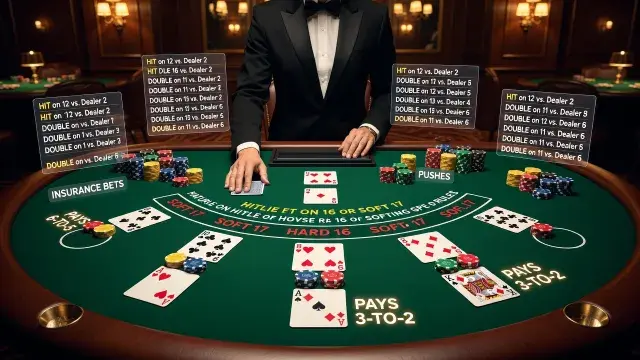

A blackjack player who never deviates from basic strategy hands the casino roughly a 0.5 percent edge. Deviate even slightly - hit when you should stand, skip a double down out of nerves - and that number climbs past 2 percent, sometimes higher. Few casino games punish improvisation so precisely, and few reward discipline so consistently. That gap between careless play and informed play is the entire subject of this article.
Most people learn the basics from a friend, a movie, or a few confused hands at a casino table, which explains why so many players misunderstand what is blackjack card game actually asking of them. For a full breakdown of the game's origins and objective, the guide at what is blackjack card game is a useful starting point, but the practical mechanics - how bets resolve, when the dealer must hit, what a blackjack actually pays - matter more at the table than history does. Those mechanics are where most losing players go wrong.
This piece breaks the game down in the order a serious player needs it: the rules that govern every hand, the payout structure that determines whether a table is worth sitting at, the odds that explain why the house wins over time, and the strategy that narrows the gap as far as mathematically possible.
Understanding the Basics of Blackjack
The Objective of the Game
Blackjack is not a race to 21 - it's a comparison. The goal is to finish with a hand value closer to 21 than the dealer's, without exceeding it. A player can win with a total of 12 if the dealer busts. This distinction matters because new players often chase 21 itself, taking unnecessary hits and busting hands that were already ahead.
Card Values and Hand Totals
Number cards count at face value, face cards count as 10, and the ace counts as either 1 or 11, whichever benefits the hand more. A hand containing an ace valued at 11 is called "soft" - a soft 17, for instance, is an ace and a 6. Soft hands play differently than hard hands because the ace gives them flexibility to absorb a high card without busting.
The Role of the Dealer
Unlike other players at the table, the dealer follows fixed rules with no discretion. This single fact is what makes blackjack solvable through strategy - the dealer's behavior is predictable, which means optimal player decisions can be calculated in advance rather than guessed at.
Core Blackjack Rules Every Player Must Know
Dealing and Table Setup
Each player receives two cards face up; the dealer receives one face up and one face down (the "hole card"). Play moves clockwise around the table, with each player acting before the dealer reveals or draws additional cards. Table limits and the number of decks in play - commonly six or eight - affect the odds slightly, since more decks reduce the frequency of natural blackjacks.
Player Options: Hit, Stand, Double, Split
Blackjack rules give players four primary decisions on any given hand:
- Hit - take another card
- Stand - keep the current total and end the turn
- Double down - double the wager in exchange for exactly one more card
- Split - separate two matching cards into two independent hands, each requiring its own bet
Some tables also permit surrender, allowing a player to forfeit half their bet and exit a hand before drawing further cards. This option isn't universal, and its availability meaningfully affects long-term results for players who use it correctly.
Insurance and Even Money
When the dealer shows an ace, players may place an insurance bet, wagering that the dealer's hole card gives them blackjack. It pays 2 to 1 but is generally a poor bet mathematically, since it's only profitable in specific card-counting situations that recreational players rarely track.
How to Play Blackjack Step-by-Step
Placing Your Bet
Betting happens before any cards are dealt, and the minimum and maximum limits are usually posted directly on the table. Choosing a table within a comfortable bankroll range matters more than most players admit - going all-in on strategy while ignoring bankroll math is a common way to turn a mathematically sound approach into a losing session.
Reading Your Hand and the Dealer's Upcard
Every decision in blackjack strategy hinges on two pieces of information: the player's total and the dealer's single visible card. A player holding 16 against a dealer's 6 should stand, because the dealer's weak upcard makes a bust likely. That same 16 against a dealer's 10 usually calls for a hit, since the dealer is far more likely to make a strong hand.
Making Decisions in Sequence
Players act one at a time, completing their entire hand - hitting, standing, doubling, or splitting - before the next player begins. Only after every player has acted does the dealer reveal the hole card and play out their own hand according to fixed rules.
Blackjack Payouts and Dealer Rules Explained
Standard Payout Structures
A winning hand typically pays 1 to 1 - bet ten, win ten. A natural blackjack (an ace plus a ten-value card dealt as the first two cards) traditionally pays 3 to 2, meaning a $10 bet returns $15. Some tables have shifted to 6 to 5 payouts on blackjacks, which sounds like a minor change but significantly increases the house edge over time. Recognizing this difference before sitting down is one of the simplest ways to protect your bankroll.
Fixed Dealer Behavior
Dealers must hit on any total of 16 or below and stand on 17 or above. Some casinos require the dealer to hit on a soft 17 (an ace and a 6), which increases the house edge slightly compared to tables where the dealer stands on soft 17. This single rule variation is worth checking before playing, since it directly affects the odds without changing anything visible about how the game looks.
Push, Bust, and Tie Outcomes
If the player and dealer finish with equal totals, the hand is a push, and the original bet is returned with no gain or loss. If either the player or dealer exceeds 21, that hand busts immediately and loses, regardless of what the other party eventually draws.
Blackjack Card Game Odds and House Edge
Why the House Has an Edge
The house edge in blackjack exists primarily because the player must act first. If the player busts, the hand is lost immediately, even if the dealer would have busted too. This sequencing advantage is baked into the game's structure and can't be eliminated, only minimized through correct play.
How Deck Count Affects Odds
Single-deck games generally favor the player slightly more than multi-deck shoes, because fewer decks make card counting more effective and natural blackjacks statistically more frequent relative to total hands dealt. Six- and eight-deck shoes, common in most modern casinos, dilute this effect and typically carry a marginally higher house edge.
Comparing Blackjack Odds to Other Casino Games
Blackjack card game odds, when played with correct strategy, produce one of the lowest house edges of any casino table game - often under 1 percent, compared to several percentage points on games like roulette or slot machines. This is precisely why blackjack attracts players who treat gambling as a skill-influenced pursuit rather than pure chance.
Blackjack Strategy for Consistent Results
Basic Strategy Charts
Basic strategy is a set of predetermined decisions for every possible combination of player hand and dealer upcard, derived through probability calculations rather than intuition. Memorizing this chart, even imperfectly, closes most of the gap between casual play and optimal play.
When to Split Pairs and Double Down
Certain pairs, like aces and eights, should almost always be split - aces because two strong starting hands beat one mediocre one, eights because a total of 16 is one of the weakest hands in the game. Doubling down works best on totals of 10 or 11 against a weak dealer upcard, where the odds of drawing a strong final card are favorable.
Bankroll Management and Betting Discipline
No strategy survives careless bankroll management. Setting a fixed session limit, betting a small consistent percentage of the total bankroll per hand, and walking away after reaching a loss threshold all matter as much as knowing when to hit or stand.
Common Mistakes That Cost Players Money
- Taking insurance without a card-counting reason to do so
- Standing on soft hands out of fear rather than strategy
- Splitting tens, which breaks up an already strong hand
- Ignoring the dealer's upcard when deciding whether to hit
Frequently Asked Questions
Is blackjack strategy the same at every casino?
No. Basic strategy shifts depending on the number of decks in play, whether the dealer hits or stands on soft 17, and whether surrender is offered. A strategy chart built for one rule set can produce worse results at a table with different dealer rules.
Does card counting still work in modern casinos?
Card counting is mathematically sound, but continuous shuffling machines and frequent deck reshuffling in many casinos reduce its practical effectiveness. It remains more viable in single- or double-deck games dealt without automatic shufflers.
What's the difference between a soft hand and a hard hand?
A soft hand contains an ace counted as 11, giving it flexibility since the ace can drop to 1 if another card would otherwise cause a bust. A hard hand either has no ace or one that can only count as 1, making its total fixed and less forgiving.
Should I always take insurance when the dealer shows an ace?
No. Insurance is a side bet that only pays off if the dealer has blackjack, and the base odds of that happening don't favor the bet for most players. It's generally a losing proposition outside of specific card-counting scenarios.
Why do some tables pay 6 to 5 instead of 3 to 2 for blackjack?
Casinos use the 6 to 5 payout to increase their house edge without changing visible rules like hit/stand structure. It looks like a small difference but meaningfully reduces long-term player returns, so seeking out 3 to 2 tables is worth the effort.
Can basic strategy guarantee winning sessions?
No strategy guarantees a win in any individual session, since blackjack still involves genuine variance. What basic strategy guarantees is the lowest possible house edge over a large number of hands, which improves long-term outcomes without eliminating short-term luck.